See both perspectives.
View two model rankings side by side. Differences stay visible rather than disappearing into an average.
Open the patient view ↗A workbench for exploring intracranial EEG. Compare models, inspect the signal behind a ranking, and keep disagreements in view.
Research prototype · Public and synthetic data · No treatment recommendations
Follow the working Python pipeline from a generated recording to a finding you can inspect. Select a step to see what happens inside.
onset/synth.pyMNE creates five virtual patients with background activity, interictal spikes, fast bursts, a seizure, and noisy contacts. The labels are known because the data are synthetic.
The current assistant uses Python rules. LLM agents, a clinical database, and an immutable run registry are future extensions.
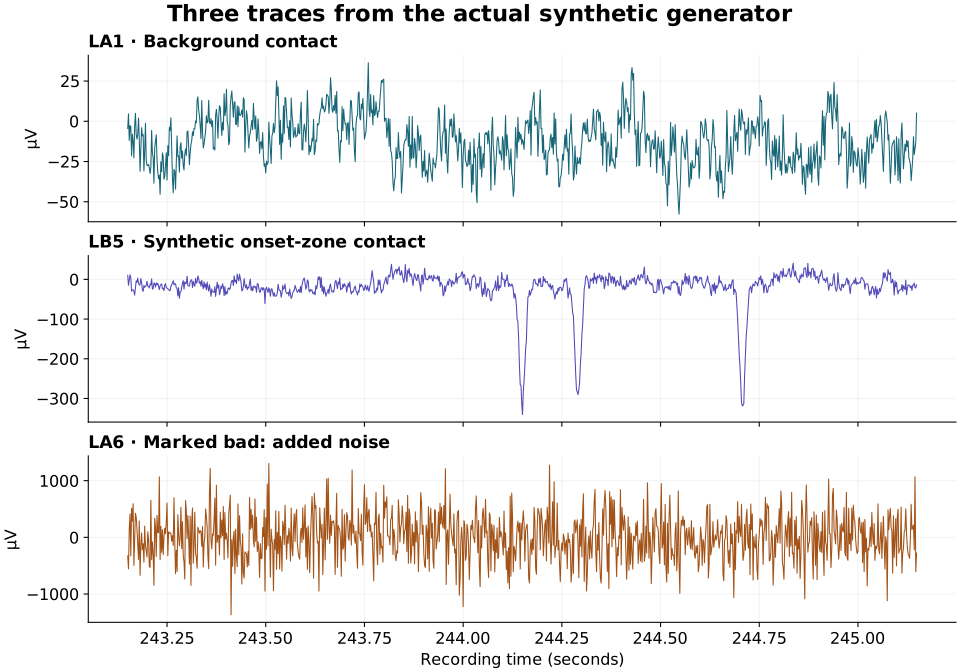
A large transient, a high-frequency burst, and a noisy contact can look very different in context. A single score cannot tell the whole story.
Onset connects each model’s ranking to selected signal windows, so you can explore what sits behind the output. These windows are examples associated with the score—not proof of a clinical conclusion.
Epilepsy evaluation combines signals, imaging, clinical history, and expert interpretation. This prototype explores one narrow task: making model evidence easier to find and compare.
View two model rankings side by side. Differences stay visible rather than disappearing into an average.
Open the patient view ↗Move from a contact to its model-specific evidence window. Examine signal quality and the surrounding context.
Understand the evidence →A structured report brings together findings, disagreements, data quality, and limitations. It does not recommend treatment.
Explore a report ↗This is a proposed workflow benefit, not a measured clinical result. Onset has not demonstrated time savings or improved patient outcomes. See how we would test its usefulness.
Onset-HFO carries these methods onto public intracranial recordings from twenty patients who went to epilepsy surgery. The archive ships expert-marked high-frequency oscillations, the contacts the surgeon removed, and whether the seizures stopped — so a ranking can be checked against something other than another algorithm.
The channel generating the most fast ripples sat inside the resected tissue in 11 of 13 patients who became seizure-free, against 3 of 7 whose seizures returned: AUC 0.71, p = 0.12. Thirteen against seven cannot establish that, and an earlier analysis of the first 60 seconds of the same recordings said something stronger. Both tables are published side by side, because the disagreement between them is the finding.
Open the real-data appTwo public CC0 archives · 41,187 expert-marked events · Underpowered, and says so
Developed in the Brain–Machine Interfaces Lab at Nazarbayev University, led by Berdakh Abibullaev. Onset connects localization-model research with the practical work of presenting traceable evidence.
Two repositories, both open. Onset is the synthetic workbench this page describes, built to be read end to end. Onset-HFO runs the same ideas against public patient recordings and publishes what they are worth. See also the interactive design mockup for a proposed future interface.
Implemented: synthetic MNE recordings, bipolar features, two baseline rankers, leave-one-patient-out evaluation, deterministic reports, a rule-based assistant, and the Streamlit interface.
Implemented in Onset-HFO: loaders for two public CC0 iEEG archives, two HFO detectors that differ only in the feature they threshold, artifact rejection on each event’s own spectrum, scoring against 41,187 expert-marked events, the surgical-outcome study, and an assistant on an open-weight model that must cite the results and is refused by code when it strays.
Proposed: authorized clinical-data ingestion, persistent versioned runs, access control, audit, and bounded LLM tools. The downloadable Qwen example is an optional teaching lab, not part of the live assistant. Clinical usefulness remains to be evaluated.
Read the research and validation roadmap →